Search This Blog

Showing posts sorted by relevance for query "Genesis 21". Sort by date Show all posts

Thursday, February 13, 2025

Genesis Quick Links - Reflections

Here are the quick links to each study in Genesis

  • Genesis 1-3
  • Genesis 4-7
    • Genesis 4 Cain and Abel
    • Genesis 5 Adam's Descendants to Noah
    • Genesis 6 Increasing Corruption on Earth & Noah and the Flood
    • Genesis 7 Noah and the Flood
  • Genesis 8-11
    • Genesis 8 The Flood Subsides & God's Covenant with Noah
    • Genesis 9 God's Covenant with Noah & Noah's Descendants
    • Genesis 10 Nations Descended from Noah
    • Genesis 11 The Tower of Babel & Shem's Descendants & Terah's Descendants
  • Genesis 12-15
    • Genesis 12 The Call of Abram & Abram and Sarai in Egypt
    • Genesis 13 Abram and Lot Separate
    • Genesis 14 Abram Rescues Lot & Abram Blessed by Melchizedek
    • Genesis 15 God's Covenant with Abram
  • Genesis 16-18
    • Genesis 16 Sarai and Hagar
    • Genesis 17 Abraham and the Covenant of Circumcision & Isaac's Birth Promised
    • Genesis 18 Isaac's Birth Promised & Abraham Intercedes for Sodom
  • Genesis 19-21
    • Genesis 19 God Rescues Lot, God Destroys Sodom, & Lot and His Daughters
    • Genesis 20 Abraham and Abimelech
    • Genesis 21 The Birth of Isaac, God Protects Hagar and Ishmael, & A Treaty with Abimelech
  • Genesis 22-24
    • Genesis 22 The Sacrifice of Isaac
    • Genesis 23 Sarah's Death and Burial
    • Genesis 24 Isaac and Rebekah
  • Genesis 25-26
    • Genesis 25 Abraham's Death and His Descendants, The Birth of Esau and Jacob, & Esau Sells His Birthright
    • Genesis 26 God's Promise to Isaac & Isaac and Abimelech
  • Genesis 27-29
    • Genesis 27 Isaac Blesses Jacob
    • Genesis 28 Jacob Sent to Laban & Esau Marries an Ishmaelite & Jacob's Dream
    • Genesis 29 Jacob Marries Leah and Rachel & Jacob's Children
  • Genesis 30-31
    • Genesis 30 Jacob's Children & Jacob's Prosperity
    • Genesis 31 Jacob Flees from Laban
  • Genesis 32-34
    • Genesis 32 Jacob Fears Esau & Jacob Wrestles with God
    • Genesis 33 Jacob Meets Esau
    • Genesis 34 The Defiling of Dinah
  • Genesis 35-37
    • Genesis 35 God Blesses and Renames Jacob & The Deaths of Rachel and Isaac
    • Genesis 36 Esau's Descendants
    • Genesis 37 Joseph's Dreams & Joseph Sold by His Brothers
  • Genesis 38-40
    • Genesis 38 Judah and Tamar
    • Genesis 39 Joseph and Potiphar's Wife
    • Genesis 40 Joseph Interprets Two Prisoners' Dreams
  • Genesis 41-42
    • Genesis 41 Joseph Interprets Pharaoh's Dreams & Joseph Rises to Power
    • Genesis 42 Joseph's Brothers Go to Egypt
  • Genesis 43-45
    • Genesis 43 Joseph's Brothers Return to Egypt
    • Genesis 44 Joseph Tests His Brothers
    • Genesis 45 Joseph Provides for His Brothers and Family
  • Genesis 46-47
    • Genesis 46 Joseph Brings His Family to Egypt & Jacob and Joseph Reunited
    • Genesis 47 Jacob's Family Settles in Goshen & Joseph and the Famine
  • Genesis 48-50
    • Genesis 48 Jacob Blesses Ephraim and Manasseh
    • Genesis 49 Jacob Blesses His Sons & Jacob's Death and Burial
    • Genesis 50 Jacob's Death and Burial, God's Good Purposes, & The Death of Joseph


Tuesday, March 3, 2026

Galatians 4:21-31


The Allegory Of Abraham’s Two Sons,                        4:21-31
Synopsis:         Do you desire to be under the Law?  Abraham had two sons. One son by the handmaid, Hagar. The other son by the free woman, Sarah.  One son was born after the flesh. The other son was born by promise.  These two sons represent the two covenants, the Old Covenant and the New Covenant. The son of Hagar represented the law of Moses, which was bondage.  The son of Sarah represented the New Covenant, which was freedom.  The slave woman and her son were to be cast out.  Christians are not of the slave woman. Christians are of the free woman.
21         Tell me, ye that desire to be under the law, do ye not hear the law?
To those who wanted to be under the law, Paul asked, do you not hear the law?  Paul used an allegory to explain the meaning to them. He gave the spiritual meaning to a familiar Old Testament story (Genesis 16:1-4; 21:1-12).  The law taught it brings one into bondage. Paul taught freedom in Christ.
22         For it is written, that Abraham had two sons, one by the handmaid, and one by the free woman.
Abraham had two sons.  Ishmael was the son of the slave, Hagar. Isaac was the son of the free woman, Sarah.
23         Howbeit the son by the handmaid is born after the flesh; but the son by the free woman is born through promise.
Ishmael was born in the natural way.  The union between Abraham and Hagar produced Ishmael.  Isaac was born as a result of the promise God made to Abraham and the faith Abraham had in God even after he had lost the power to have children (Romans 4:19; Hebrews 11:11-12).
24         Which things contain an allegory: for these women are two covenants; one from mount Sinai, bearing children unto bondage, which is Hagar.
The story of the two women and their sons was an allegory. The two women represented two covenants.  The covenant made to Abraham (4:18; 3:8, 16-18).  And the covenant made at mount Sinai with the children of Israel (Galatians 3:19, 24).  It was the law of Moses versus the New Covenant.  Hagar represented the law of Moses.  She was a slave and her children were in bondage.
25         Now this Hagar is mount Sinai in Arabia, and answereth to the Jerusalem that now is: for she is in bondage with her children.
Hagar stood for the law given at mount Sinai, which is in Arabia. In this allegory, the physical Jerusalem represented the law of Moses and the Judaizing teachers.  Hagar and her children were in bondage.  The Jews were in bondage as well as the Judaizing teachers.
26         But the Jerusalem that is above is free, which is our mother.
In verses 25 and 26, Paul mixed metaphors.  The contrast was first between the present Jerusalem and the future Jerusalem.  The second contrast was between Jerusalem below and Jerusalem above.  The Jerusalem below represented the law of Moses and its bondage.  The Jerusalem which was above represented the new covenant and its freedom.  The new Jerusalem was the mother of Christians.
27         For it is written, Rejoice, thou barren that bearest not; Break forth and cry, thou that travailest not; For more are the children of the desolate than of her that hath the husband.
Paul quoted Isaiah 54:1.  The context was about the Babylonian captivity when Jerusalem was barren of her children.  The promise was that later she would have more children.  It was applied to Sarah and Hagar.  Sarah was barren at first.  The application was to the church.  Already there were more Gentile Christians than Jewish Christians.  The day would come when there would be more Christians than physical Jews.
28         Now we, brethren, as Isaac was, are children of promise.
Christians are children of promise like Isaac.  The true spiritual children of Abraham are those who believe in Jesus Christ and obey the gospel (Galatians 3:6-7). In this allegory the Jews were children of Hagar and Christians are children of Sarah and Isaac.
29         But as then he that was born after the flesh persecuted him that was born after the Spirit, so also it is now.
When Isaac was weaned, Ishmael was found mocking Isaac (Genesis 21:8-9).  Ishmael was the one born after the flesh.  Isaac was the one born after the Spirit.  Paul taught it was the same today.  The descendants of Ishmael (the Jews and Judaizing teachers) were persecuting the descendants of Isaac (Christians).
30         Howbeit what saith the scripture?  Cast out the handmaid and her son: for the son of the handmaid shall not inherit with the son of the free woman.
Sarah demanded Hagar and Ishmael be cast out of the home (Genesis 21:10).  God supported this (Genesis 21:12).  Ishmael could not inherit along with Isaac. The Jews could not inherit along with Christians. Jews could be children of promise; however, the Jews could not be children of promise by the law of Moses.  The Jews must believe in Jesus Christ and obey the gospel just as the Gentiles. The law had been "nailed" to the cross and was no longer binding.
31         Wherefore, brethren, we are not children of a handmaid, but of the freewoman.
Paul summed up his argument by stating Christians were not children of Hagar, the slave woman.  Christians were children of Sarah, the free woman.  Christians were no longer in bondage under the law. Christians were spiritual sons of Abraham in Jesus Christ by obedience to the gospel.


Wednesday, January 29, 2025

Genesis 19-21 = Week 04 - Wednesday

Lot's Poor Choices

Read Genesis & See Chapter Headings
Read Genesis 19

In this lesson we see the very real consequences of Lot's choices concerning where he chose to live with his family after separating from Abraham. (Genesis 18:1-19;38)


The Source of Islam


In chapters 20 and 21 of Genesis we read about Abraham's continued walk of faith and a description of the people who where the source for the religion of Islam.


Monday, January 6, 2025

Genesis 3 The Fall = Week 01 - Monday

The Fall

Genesis 3

PICTURE

Reminder: Pray to God to set your heart right as you engage His word. The text you are about to study was not written to you but is written for you. So, before applying we must ask the following questions:
  • What did it mean to the original reader or original audience?
READ THE SCRIPTURE (Multiple times & translations and notice the words that standout)
Biblegateway (NIV, ESV, NET, AMP, NLT) (My choice of all-round site. It is a Great app, better on computers, but works on smartphones)
ESV (English Standard Version) Good translation with some helpful resources.
Biblia.com (New Century Version) (Great on a computer especially if you have a logos account)


Themes
Adam
Eve
Good and Evil

Topics


Potential Sermon Titles: ??

Intro Questions to get us thinking:

ESV Text with Highlights
#God = 
#People = 
  • Adam
  • Eve
#Time = 
#Place = 
#Obedient faith = 
#Sin = 
#Key Idea = 

Genesis 3-5 ESV


OBSERVATIONS (Reflect on the topic and build the concept the writer is trying to communicate to the original audience)
ebible (NLT) (Best for having Bible sections divided by "pericope" or sections by thought)
Bible Project (NLT) (Helpful videos and instructions for the bigger picture)
Thematic Bible (Books and Chapters Structure)
Bible Hub = Outline, Themes, Topics, People, Locations, and Questions


STUDY RESOURCES (This takes some work and here are more resources than you can go through completely)
Rhys N. Thomas @ Thomas Theology Hub is a great resource.
NETBible (New English Translation) (Great for original text information)
StepBible (ESV) (Great on phone or computer with good resources.)
Literal Word  (New American Standard Bible) (Works well on a smartphone or computer + for searching for words like a printed concordance)
BlueLetter  (King James Version) (A variety of resources and good on Phones / better on Computers)
BibleHub (HCSB, BSB) (Good on computer or app/phone with lots of well-organized information.)
BibleRef.com (New King James Version) Basic able to compare core translations.
StudyLight (Amplified Bible) (Great site with commentaries by Burton Coffman)
KnowingJesus (Phone / Computer and great for comparing translations)
Bible.com (Lexham English Bible)
  • God is ... What do we learn about God in this passage?
  • We are ... What do we learn about people in this passage?


APPLICATION (God wants us all to arrive at action, life-changing faith)
Biblegateway (ICB, CSB, NLT, MSG) has some application resources. (An easy-to-read paraphrase that helps some with application)
Heartlight (Great for practical application of scripture)

  • I will ... What has the Holy Spirit revealed to us in this passage? How can I apply it to my life this week?
  • What transformative move needs to be made?
  • You can ... Who do you know who needs to hear this? Feel free to share with others via social media links at this bottom.


Take Away Challenges
  • What has the Holy Spirit revealed to you in this passage? How will you apply it to your life this week?
  • Whom do you know who needs to hear this?
  • What is God bringing to your attention in this discussion? What beliefs, thoughts, or actions need to be addressed or changed?

PRAYER:  In the Name of Jesus.


Other Resources:


  • Discovery Bible Study

  • Articles

  • Devotions
Daily Hope Devotionals
  • Links 

Please let me know if you find any broken links or corrections that need to be made. Thank you for helping to make this useful.


Read Genesis & See Chapter Headings
Read Genesis 3


The Devil is in the Details (Genesis 3:1)  by Jim Brinkerhoff
Fallout (Genesis 3:16-17) by Jim Brinkerhoff

The First Appearance of Satan in the Bible. This lesson explains the first glimpse of Satan in the physical world and examines information about this spiritual being from various Bible writers.


Eve's 5 Mistakes. This lesson reviews the mistakes Eve made which led her to committing the first sin in human history.


The Judgment. After Adam and Eve's sin the Bible describes the judgement imposed on Satan, Eve and Adam.


Paradise Lost. In this lesson God describes the consequences of sin on Adam, Eve, and the creation.


**************
Blaming Others - Confession of Sin

   Blame never affirms, it assaults.
   Blame never restores, it wounds.
   Blame never solves, it complicates.
   Blame never unites, it separates.
   Blame never smiles, it frowns.
   Blame never forgives, it rejects.
   Blame never forgets, it remembers.
   Blame never builds, it destroys.
   Let's admit it -- not until we stop blaming will we start enjoying health and happiness again!

See:  Gen 3:12

****************


****************

Read Genesis & See Chapter Headings
Read Genesis 4


Cain and Abel. This lesson explores the series of events leading up to the first murder.


The Punishment of Cain. This passage looks at the result of Cain's sin and the punishment meted out to him by God. (4:9-24)


Seed of Promise. In this section of Genesis the author identifies and traces the lineage of those people who will eventually deliver the Seed of Promise to mankind. (4:25-5:32)


Read Genesis & See Chapter Headings
Read Genesis 5

Genesis 5-6 The Flood Story — What Might We Learn?
http://johnmarkhicks.com/2012/07/06/the-flood-story-how-might-we-learn/


Seed of Promise. In this section of Genesis the author identifies and traces the lineage of those people who will eventually deliver the Seed of Promise to mankind. (4:25-5:32)


==========

The Entrance Of Sin  Genesis 3-5

"I was afraid because I was naked; so I hid" (Gen. 3:10).

One of the great mysteries that puzzles philosophers is solved in Genesis 3. Sin is no unexplained remnant of humanity's supposed rise from beastiality, but a heritage flowing from Adam's fall. Yet the focus in these two chapters is not on the fact of sin, but on its consequences.

  • Eve succumbed to temptation and induced Adam to disobey God (3:1-6). 
  • Overcome by guilt and shame, the pair ran from the Creator God who loved them (vv. 7-10). 
  • God found them and explained the consequences of their act (vv. 11-20). 
  • God Himself offered history's first sacrifice (v. 21) and led them from the Garden (vv. 22-24). 
  • Adam and Eve lived to see sin's consequences in their own family as Cain killed his brother Abel (4:1-16). 
  • Lamech, Cain's descendant, represents the sinful society that emerged (vv. 17-26).

Man is not as bad as he can be. But mankind, separated from God, is as bad off as it can be.

==============


===============


 ==================


Wednesday, June 11, 2025

Proverbs 21:1-31 The Divine Discernment: Insights from Proverbs = Week 23 - Saturday

The Divine Discernment: Insights from Proverbs

Proverbs 21:1-31


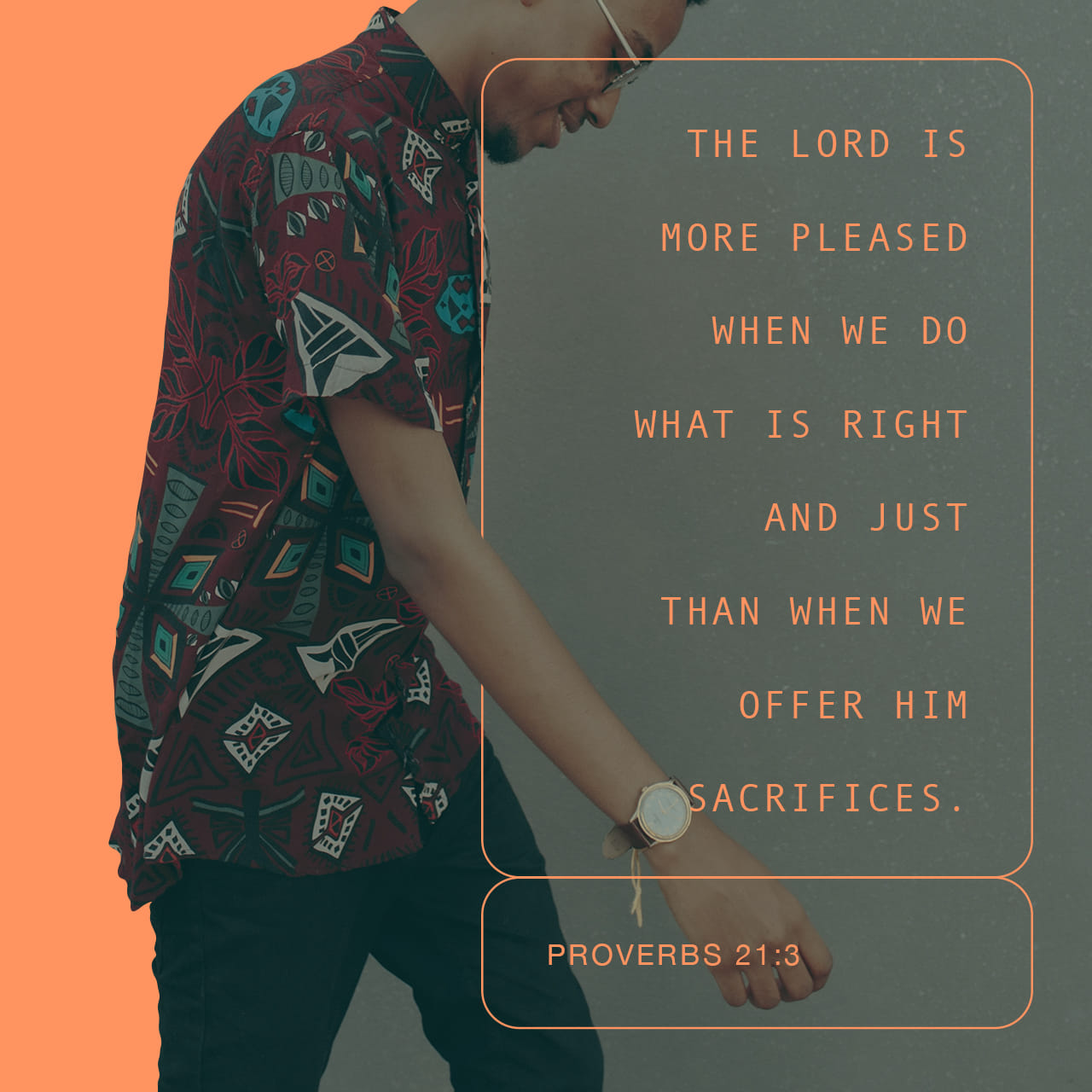
The Lord is more pleased when we do what is right and just than when we offer him sacrifices.


Reminder: Pray to God to set your heart right as you engage His word. The text you are about to study was not written to you but is written for you. So, before applying we must ask the following questions:
  • What did it mean to the original reader or original audience?
READ THE SCRIPTURE (Multiple times & translations and notice the words that standout)
Biblegateway (NIV) (My choice of all-round site. It is a Great app, better on computers or on smartphones)
StepBible (ESV) (Great on phone or computer with good resources.)
Literal Word  (New American Standard Bible) (Works well on a smartphone or computer + for searching for words like a printed concordance)
Biblia.com (New Century Version) (Great on a computer especially if you have a logos account)


Themes
Wisdom and Prudence
Divine Sovereignty
Human Conduct
Justice and Righteousness
The Consequences of Action

Topics
Divine Control
The Righteous and the Wicked
The Importance of Wisdom
Human Behavior and Consequences
The Role of Charity


Potential Sermon Titles: ??

Intro Questions to get us thinking:
  • What kind of character do you think you'd most enjoy portraying in a play? Why? How are you like, or unlike, that character? 

ESV Text with Highlights
#God = 
#People = The King, The Righteous, The Wicked
#Time = 
#Place = The House of the Righteous, The City
#Obedient faith = 
#Sin = 
#Key Idea = 

Proverbs 21 ESV

1The king’s heart is a stream of water in the hand of the Lord;
he turns it wherever he will.
2Every way of a man is right in his own eyes,
but the Lord weighs the heart.
3To do righteousness and justice
is more acceptable to the Lord than sacrifice.
4Haughty eyes and a proud heart,
the lampa of the wicked, are sin.
5The plans of the diligent lead surely to abundance,
but everyone who is hasty comes only to poverty.
6The getting of treasures by a lying tongue
is a fleeting vapor and a snare of death.b
7The violence of the wicked will sweep them away,
because they refuse to do what is just.
8The way of the guilty is crooked,
but the conduct of the pure is upright.
9It is better to live in a corner of the housetop
than in a house shared with a quarrelsome wife.
10The soul of the wicked desires evil;
his neighbor finds no mercy in his eyes.
11When a scoffer is punished, the simple becomes wise;
when a wise man is instructed, he gains knowledge.
12The Righteous One observes the house of the wicked;
he throws the wicked down to ruin.
13Whoever closes his ear to the cry of the poor
will himself call out and not be answered.
14A gift in secret averts anger,
and a concealed bribe,c strong wrath.
15When justice is done, it is a joy to the righteous
but terror to evildoers.
16One who wanders from the way of good sense
will rest in the assembly of the dead.
17Whoever loves pleasure will be a poor man;
he who loves wine and oil will not be rich.
18The wicked is a ransom for the righteous,
and the traitor for the upright.
19It is better to live in a desert land
than with a quarrelsome and fretful woman.
20Precious treasure and oil are in a wise man’s dwelling,
but a foolish man devours it.
21Whoever pursues righteousness and kindness
will find life, righteousness, and honor.
22A wise man scales the city of the mighty
and brings down the stronghold in which they trust.
23Whoever keeps his mouth and his tongue
keeps himself out of trouble.
24“Scoffer” is the name of the arrogant, haughty man
who acts with arrogant pride.
25The desire of the sluggard kills him,
for his hands refuse to labor.
26All day long he craves and craves,
but the righteous gives and does not hold back.
27The sacrifice of the wicked is an abomination;
how much more when he brings it with evil intent.
28A false witness will perish,
but the word of a man who hears will endure.
29A wicked man puts on a bold face,
but the upright gives thought tod his ways.
30No wisdom, no understanding, no counsel
can avail against the Lord.
31The horse is made ready for the day of battle,
but the victory belongs to the Lord.


OBSERVATIONS (Reflect on the topic and build the concept the writer is trying to communicate to the original audience)
ebible (NLT) (Best for having Bible sections divided by "pericope" or sections by thought)
Bible Project (NLT) (Helpful videos and instructions for the bigger picture)
Thematic Bible (Books and Chapters Structure)
Bible Hub = Outline, Themes, Topics, People, Locations, and Questions

(PROVERBS 21)

Wisdom Instructs on Integrity, Patience, and God’s Sovereignty.


  • God Watches the Heart (21:1–8): The Lord examines our heart more than our actions.

  • It’s Simpler Being Alone (21:9–19): It is better than having a contentious wife or simple, wicked companions.

  • The Way of the Wise (21:20–29): “Whoever pursues godliness and unfailing love will find life, godliness, and honor.”

  • “Victory Belongs to the Lord” (21:30–31): “Human plans, no matter how wise or well advised, cannot stand against the Lord.”

==================
Proverbs Chapter 21 offers wisdom on a range of topics, emphasizing the importance of righteousness, justice, and wise living. It highlights that:
  • God's Sovereignty: God controls the hearts of kings and rulers, guiding their decisions.
  • Righteousness Over Ritual: True righteousness and justice are more valuable to God than mere ritualistic acts.
  • Wisdom in Actions: Wise and thoughtful actions lead to success and peace, while foolishness leads to trouble.
  • Humility vs. Pride: Humble individuals are favored by God, whereas prideful behavior leads to downfall.
  • Justice and Integrity: Upholding justice and integrity is crucial, and dishonest practices will ultimately be punished.
  • Diligence and Planning: Hard work and careful planning are rewarded, while laziness and poor planning lead to failure.
Overall, the chapter encourages living a life of integrity, humility, and wisdom in alignment with God's principles.


STUDY RESOURCES (This takes some work and here are more resources than you can go through completely)
Rhys N. Thomas @ Thomas Theology Hub is a great resource.
NETBible (New English Translation) (Great for original text information)
BlueLetter  (King James Version) (A variety of resources and good on Phones / better on Computers)
BibleHub (HCSB) (Good on computer or app/phone with lots of well-organized information.)
BibleHub (BSB) (Good on computer or app/phone with lots of well-organized information.)
BibleRef.com (New King James Version) Basic able to compare core translations.
StudyLight (Amplified Bible) (Great site with commentaries by Burton Coffman)
KnowingJesus (Phone / Computer and great for comparing translations)
Bible.com (Lexham English Bible)
  • God is ... What do we learn about God in this passage?
  • We are ... What do we learn about people in this passage?
  • If this chapter were a play, what would the cast of characters look like? Who has the lead role? Does Solomon have in mind real people, or is his cast of characters largely symbolic? Symbolic of what? 
  • How are the first eight verses linked thematically to one another? How are the themes of heart attitude and right behavior linked? What do the images of "haughty eyes" and "lying tongue" have in common? Likewise, what is the contrast linking "watercourse" with "fleeting vapor"? 
  • Knowing that kings are subject to the King of kings (v 1), what does that say about what a subject can expect from a king and vice versa? 
  • Why does the Lord regard "sacrifice" (vv. 3,27) as unacceptable, even detestable? What does he want instead (see 15:8; Mic 6:7-8)? What does this say about mere religious ritual or orthodox belief? Why are spiritual reality and practical justice more acceptable? 
  • The pursuit of justice brings "joy" (v. 15) among other blessings (v. 21), but the direct pursuit of "pleasure" leads to poverty (v. 17). How do you explain that paradox? 
  • As for the poor, what happens when we ignore and when we heed their cry for justice and mercy (v. 13; see 14, 21, 31)? Positively restated, what does this proverb and related ones suggest we do for the poor (see 22:9; 28:8; 31:9)? 
  • What do verses 14, 20 and 26 add to this subject of stewardship? 


APPLICATION (God wants us all to arrive at action, life-changing faith)
ESV (English Standard Version) Good translation with some helpful resources.
Biblegateway (Christian Standard Bible) has some application resources.
The Message (MSG) (An easy-to-read paraphrase that helps some with application)
Heartlight (Great for practical application of scripture)
  • If the proverbial types in this chapter were characters in a play, which one(s) would get your standing ovation? Why? With whom would you feel the most empathy? Why? 
  • Verse 1 expresses the truth proverbially what Tiglathpileser (Isa 10:6-7), Cyrus (Isa 41:2-4) and Artaxerxes (Ezr 7:21) exemplify historically. Where do you see this principle in force today? How does that affect your view of those in authority, even pagan leaders? How are pagan leaders subservient to God? 
  • We tend to exert authority as kings in our own right, but in reality we are subject to God's heart-searching authority (vv. 2, 30, 31; see 16:2; Heb 4:12). How have you tried to prevail against the Lord? What was the result? What victory did you experience with the Lord? 
  • What does it mean for God's people to make sacrifices with "evil intent" (v. 27; see Isa 1:11-15 on "evil assemblies")? What is the result to God? To us? To others? 
  • What different feelings do verses 9 and 19 arouse in the men and women of your group? Why? Where are you living these days? Why there?
  • I will ... What has the Holy Spirit revealed to us in this passage? How can I apply it to my life this week?
  • What transformative move needs to be made?
  • You can ... Who do you know who needs to hear this? Feel free to share with others by social media links at the bottom of this.

Take Away Challenges
  • What has the Holy Spirit revealed to you in this passage? How will you apply it to your life this week?
  • Whom do you know who needs to hear this?
  • What is God bringing to your attention in this discussion? What beliefs, thoughts, or actions need to be addressed or changed?

PRAYER: God, help me to trust in you and not in my own strength. In the Name of Jesus.


Other Resources:


  • Discovery Bible Study

  • Articles

  • Devotions

God's Plans and Our Plans (Proverbs)

One of the most important issues in any of our lives is that of making choices. We make them every day - big ones like who to marry, what career to choose, what city to live in. But equally as significant are the everyday decisions that we make, the consequences of which add up to be just as significant as the momentous decisions.

The choices we make are going to determine our destiny. I've heard someone say that most decisions can be made by any reasonably competent person of average intelligence. But there are a small number of decisions that are life-changing. Even the small decisions end up really making a difference because we make them on such a regular basis.

So the question really is how to make good decisions, and there are two schools of thought. One is the hands-off approach. Do you remember the Greek myth of Oedipus? Before he was born, it was prophesied that he would kill his father and marry his mother. When he grew up he was aware of this prophecy, and he tried everything to avoid his fate, yet he ended up killing the prophesy despite all of his efforts. In this view or reality, you can make all the decisions in the world, but you can't escape your fate. Your destiny is predetermined, and no matter what you do you can't avoid your fate.

The very opposite view is probably what most of us hold. It can be summed up in the famous words of the great theologian, Doc from Back to the Future. Doc said, "Your future hasn't been written yet. No one's has. Your future is whatever you make it. So make it a good one." In this view, everything is up for grabs, and you can determine your own future by the choices that you make.

Then we have a unique view that doesn't really fit into either category, and you might have been exposed to this view within the church. The view is that God has a perfect will for your life: the person you're supposed to marry, the job you're supposed to take, and so on. It's like the bull's eye. It's your job to discern what that will is through a series of steps, like praying, putting out tests for God to confirm what he wants, and sensing when you have peace. The pressure's on with this view, because if you marry the wrong person you not only miss your own bull's eye, but you have taken the bull's eye away from the person who was supposed to marry your spouse, so you've messed up things for at least three people, probably more.

So it's in this context that we come to Proverbs and ask, how in the world are we supposed to make wise decisions? Proverbs is very helpful in answering this. It's amazingly nuanced and practical when it comes to this subject.

So let's look at what Proverbs teaches us on this subject. First: our role when it comes to decisions. Second, God's role. Third, how to put our role and God's role together.

First, let's look at our role in making decisions.

Proverbs teaches us that you have a role in making decisions. For example, listen to these proverbs:

The plans of the diligent lead to profit
as surely as haste leads to poverty.
(Proverbs 21:5)

Surely you need guidance to wage war,
and victory is won through many advisers.
(Proverbs 24:6)

And if you make good decisions, you'll get to enjoy the benefits. Proverbs 31 speaks of the noble woman who embodies the wisdom described in Proverbs, and it says:

She is clothed with strength and dignity;
she can laugh at the days to come.
(Proverbs 31:25)

One of the clearest verses that describes both the importance of planning, and one of the most important ingredients in planning, is found in Proverbs 20:18:

Plans are established by seeking advice;
so if you wage war, obtain guidance.

You'd have to be crazy to go to war if you didn't have a plan. Imagine having all the troops lined up about to engage in battle when somebody asks, "OK boss, what's the plan?" "I don't know yet. We'll wing it." Armies have plans and strategies before they go to war, and they're based on lots of advice from lots of smart people. That's why there are books like The Art of War. Smart sports teams have plans before they approach a draft, like the Leafs did this past week. I hope! And you'd be crazy if you didn't have a plan. It involves thinking about goals, getting advice, thinking about the steps necessary to accomplish that goal, devising alternatives, dealing with roadblocks, and using your imagination to picture the end result.

We need to begin with the human side and say: you need to plan. Some people think it's unspiritual to plan, but Proverbs says that's bunk. Some people say that we need to go through all kinds of spiritual exercises to determine God's will. Proverbs says: no, plan. Use your brain. Get good advice. Make good decisions. So you should be planning for your future. That's the human side of planning.

Proverbs doesn't stop there, though.

Second, we need to look at God's role when it comes to the decisions that we make.

Proverbs teaches us that we have a role to play in our decisions, but so does God. Proverbs 16:1-2 says:

To human beings belong the plans of the heart,
but from the LORD comes the proper answer of the tongue.
People may think all their ways are pure,
but motives are weighed by the LORD.

What this means is that we can plan, but God may have something different in mind than what we plan. Verse 1 gives us an example. Have you ever planned what you were going to say to somebody, even planned carefully, but when you went to speak, something completely different came out? That's what verse 1 says. You can plan all you want, but if God wants you to say something different, then you're going to say something different. You can plan all that you want, but if God wants something else to happen, then something else is going to happen.

Then verse 2 says that God sees something completely different than we do. When I make a decision, I think that I'm being objective and rational, and I'm often pretty convinced that I've made the correct decision when I'm done. That's what the first part of verse 2 says: "People may think all their ways are pure." The reality is, though, that I am not impartial and rational when I make decisions. God sees my heart and my motives, and he understands that I'm often not making the best decisions because I have all kinds of mixed motives, and so do you.

Martyn Lloyd-Jones said that our problem isn't so much small-s sins, like sinful actions, as much as capital-S Sin. We have sinful hearts. John Bunyan said it well: there's enough sin in his best prayer to damn the whole world. That is, even when we are at our best, we are still full of mixed motives and selfish desires and all kinds of things that corrupt us. We can't make wise decisions like we're supposed to because our hearts are corrupt, and we lack wisdom.

Then look at Proverbs 16:9:

In their hearts human beings plan their course,
but the LORD establishes their steps.

Proverbs 19:21 says:

Many are the plans in a human heart,
but it is the LORD's purpose that prevails.

Do you see the tension? We have a role to play when it comes to decisions, but so does God. You see this especially when it comes to bad things that happen. What happens when the decisions that are made are bad ones? Proverbs 16:4 tells us:

The LORD works out everything to its proper end—
even the wicked for a day of disaster.

Here's what this means. The first part of the verse says that God is in control of everything. But the second part of the verse says that when wicked people make bad choices of their own free will, God is able to use even their free choices for good. God doesn't author evil, but he's able to use even the evil choices that people make of themselves for his own purposes. We can choose, but God ultimately gets his will done even through even the bad choices that we make. A good example is the life of Joseph in the book of Genesis. Joseph was able to say after years of being unjustly treated by others, "You intended to harm me, but God intended it for good to accomplish what is now being done, the saving of many lives" (Genesis 50:20).

There's a tension here that we really aren't going to be able to put together. Are we free to make our own choices? Yes. Do our choices really matter? Yes. But does God sovereignly determine the way things are going to turn out? Yes. The technical term for this is antinomy. It's an apparent contradiction. And if you think about it, it's really the best of both worlds.

If your decisions didn't matter, then you may as well stay in bed all day because what's the use? But if your decisions determine everything, then the pressure is on. You have to make good decisions or else. But if your decisions matter and at the same time God determines the future, then you have an important role, but you can relax knowing that God is in charge. Understanding our role and God's role brings significance to our decisions, but it also brings confidence because we know that God is at work even through our mistakes and the bad things that happen.

This also means that if you want to know what God's will is for your life, you're standing in it. God's will is not something that you discover; it's something that he does. He has you right where he wants you. So your decisions matter, but God ultimately uses those decisions so that it's his purpose that prevails. He uses even the bad things to accomplish his purposes.

But what we really need is to pull this all together.

And there's no better verse to pull this altogether than Proverbs 16:3:

Commit to the LORD whatever you do,
and he will establish your plans.

This is one of those verses that you think you know what it means, but we probably don't. We need to slow down and read it again. This is what it doesn't say. It doesn't say to make plans and then pray that God will bless them and establish them. That's not at all what it says.

It says, "Commit to the LORD whatever you do." The word commit there literally means roll. It means rolling everything you do on to the LORD, giving everything to him and keeping nothing back. This means complete dependence on God. What this means is that you stop relying on yourself, and that you roll control of your life over to God so that everything you do and who you are is completely committed to him.

This is much more than praying that God will bless what we choose. The original sin involved rolling our lives away from God and declaring independence from him. As a result, our natural condition is one of sin, of wanting our own way. But Christ has come to make a way possible back to God. Through Christ God has made it possible for us to roll our lives back on to the Lord, so that our entire lives are once again lived in submission to him.

When this happens, verse 3 says that God will establish your plans. The result of giving our entire lives over to God is that he will establish what he wants to do through us. This takes all the pressure off. Our decisions matter, but we don't bear the weight of them. We roll everything on to God, and he does with us as he pleases. And then we don't have to worry about the results. If it was all up to us, then we have pressure and all kinds of fear. But because God is sovereign, we can rest even though we know our limitations. When we commit our entire lives to God, and realize that he's sovereign, we can plan and then relax, knowing that our achievements are ultimately up to God. We can then live in prayer and peace.

So your decisions matter. But what matters most of all is that you are committed to God. When you get this balance, that your decisions matter, but God is sovereign, and that what matters even more than your decisions is that you are yielded to him - then you can work and relax, knowing that God is sovereign, and that he can work through the choices that you make.

Jack Miller was a pastor on the verge of burnout. In 1970, while pastoring a small church in Pennsylvania and teaching practical theology at a seminary, he became so discouraged that he resigned from both his church and the seminary. He had failed. People weren't changing like he knew they should.

He spent a few weeks crying. Gradually he came to realize what was wrong. He realized he had been motivated by his own personal glory and the approval of those he was serving. "He said that when he repented of his pride, fear of people, and love of their approval," his daughter writes, "his joy in ministry returned, and he took back his resignations from the church and seminary."

Miller came to a turning point. "He had been relying on the wrong person to do ministry - himself." He began to give up all dependence on himself, and began to learn the basics of doing Christian ministry in Christ's strength. The result was greater freedom and power.

Miller discovered that his actions mattered, but it's not all up to him. He learned to give up all dependence on himself, to acknowledge how poor in spirit he was, and then rely exclusively on Jesus and the gift of His Spirit in constant prayer.

Miller once wrote to a young missionary and said:

Remember the only real leader you have is Jesus Christ. Unless you are daily taught of him you will not be able to make the right decisions.

Miller discovered the joy of rolling his entire life on to the Lord, and relying on God's strength and not his own. And his life ministry was never the same.

My prayer for you is that you will make wise decisions. But my greater prayer is that you will understand that God is sovereign, and that it's only as we roll our entire lives over to him that the pressure is off, and we discover the freedom and joy that come from relying on him.

Father, I pray that you would give us wisdom as we make decisions. Thank you for the important role we play in making decisions, but thank you that you work even through our weaknesses and mistakes.

Thank you also for the invitation to trust you, to roll our lives over to you. The original sin was Adam and Eve claiming sovereignty over their own lives rather than submitting to you. Jesus Christ came to undo the results of that sin, to make it possible to once again submit to you.

Through the power of the Spirit, please convict us today in the areas in which we are trying to control our own lives, acting as little gods. Stop us from relying on the wrong person - ourselves. And bring us back to submission to you through the work of Christ and the power of your Spirit, so that every person here would realize that the only leader they have is Jesus Christ. In his name we pray, Amen.

 ===============

May 11, 2009

Living Within Your Income

by Rick Warren

In our Devotionals series, Pastor Rick Warren discusses the Bible passages that inspire him the most. Today's Devotional is based on this passage:

"Those who love money will never have enough. How meaningless to think that wealth brings true happiness! The more you have, the more people come to help you spend it. So what good is wealth—except perhaps to watch it slip through your fingers!" (Ecclesiastes 5:10-11 NLT)

When you spend more than you earn, you end up in tremendous stress. The Bible says, "Stupid people spend their money as fast as they get it" (Proverbs 21:20 TEV).

What motivates us to live beyond our means? Why do we spend ourselves into debt? Why are we rarely satisfied with what we have?

There are three myths that drive us into debt:

MYTH: Having more things will make me happier.

FACT: "Those who love money will never have enough. How meaningless to think that wealth brings true happiness!...So what good is wealth—except perhaps to watch it slip through your fingers!" (Ecclesiastes 5:10-11 NLT)

MYTH: Having more things will make me more important.

FACT: "Watch out and guard yourselves from every kind of greed; because your true life is not made up of the things you own, no matter how rich you may be" (Luke 12:15 TEV).

MYTH: Having more things will make me more secure.

FACT: "The Lord is like a strong tower, where the righteous can go and be safe. Rich people, however, imagine that their wealth protects them like high, strong walls around a city" (Proverbs 18:10-11 TEV).

When we buy into these myths, we always overspend. So, here's how to enjoy life more on less:

  • Find happiness in helping others. Jesus said, "There is more happiness in giving than in receiving" (Acts 20:35 TEV). Just look around you and you'll see this is true. The happiest people are those who help the most, not those who have the most. Misers are always miserable.
  • Find self-worth by getting to know God. God says, "...you are precious to me..." (Isaiah 43:4 TEV). You matter to God. He made you for a purpose. Genuine self-esteem comes from establishing a relationship with God and becoming all he meant for you to be.
  • Find security in trusting God, not a bank balance. The Bible says, "Keep your lives free from the love of money, and be satisfied with what you have. For God has said, 'I will never leave you; I will never abandon you'" (Hebrews 13:5 TEV). Real security must be found in something that can never be taken from you. While there are many ways to lose your possessions, Jesus said God will take care of you if you trust Him.

=============


  • Links 


    Please let me know if you find any broken links or corrections that need to be made. Thank you for the help to make this most useful.