Friday, March 31, 2023

Thursday, March 30, 2023
Wednesday, March 29, 2023
Joshua 1-4 - " " = April 25
Be Strong - A Series from Joshua
March-April 2013

Sermon Audio
Be Strong And Courageous by Randy Roper
In the first lesson in our series on Joshua, we look at how God prepared Joshua to lead Israel into the Promised Land, and how we can all find strength and courage to face the unknown in life.
The Power of The Lord by Rob Long
The power and strength of the Lord are evident in Israel's crossing of the Jordan River into the Promised Land. That same power is at work in our lives today.
When Walls Fall Down by Rob Long
God guided the armies of Israel to walk in obedience. Their obedience resulted in God's provision--the walls of Jericho coming down.
Confronting Sin by Kent Risley
Sin has lasting implications on individuals and the community surrounding that individual. Learn valuable lessons from the story of Achan in Joshua 7.
How Will You Be Remembered? by Randy Roper
If you have the opportunity to choose your final words on earth, what would say? Last words are more meaningful if they have been underscored by the way a person lived his/her life. At the end of his life, Joshua chooses to make the name of God known rather than make a name for himself.
Choose This Day by Randy Roper
Life is filled with choices. With so many decisions to make, we can easily feel overwhelmed. But one decision stands out from all the others. It is a decision that demands action and has implications. What will you choose?
Joshua 1-4
#Rahab
Discovering the Gospel in Joshua – Tim Keller
https://youtu.be/H__spWZF2iM
In the sixth episode of the Gospel in Life series "Discovering the Gospel in Every Book of the Bible", Tim Keller looks at the book of Joshua.
Each episode from this series will highlight themes that point to the Gospel and help you discover the overarching narrative of God’s Word in every book — Christ coming into the world to save us from our sins and reconcile us to God the Father.
Joshua "Introduction" God Chooses Joshua to Lead Israel = April 25
God Chooses Joshua to Lead Israel
Joshua 1:1-18
Monday, March 27, 2023
Acts 19:1-22 Twelve Disciples of John the Baptist March 27
Twelve Disciples of John the Baptist
Acts 19:1-22
What experiences have you had with religious counterfeits (relics, forgeries, hoaxes, cults and the like)? Any that have really scared you?


In His Name (The Ephesian 12) - Acts 19:1-12
======
========
===================
Acts 19:1-22
What experiences have you had with religious counterfeits (relics, forgeries, hoaxes, cults and the like)? Any that have really scared you?
#God #People #Time #Place #Obedient
faith #Sin #Key Idea
Paul in Ephesus
1And it happened that while Apollos was at Corinth, Paul passed through the inland country and came to Ephesus. There he found some disciples. 2And he said to them, “Did you receive the Holy Spirit when you believed?” And they said, “No, we have not even heard that there is a
Holy Spirit.” 3And he said, “Into
what then were you baptized?” They said, “Into John’s baptism.” 4And Paul said, “John baptized with the
baptism of repentance, telling the people to believe in the one who was to come after him, that is, Jesus.” 5On hearing this, they were baptized in the name of the Lord Jesus. 6And when Paul had laid his hands on them, the Holy Spirit came on them, and they began
speaking in tongues and prophesying. 7There were about twelve men in all.
8And he entered the synagogue and for three months spoke
boldly, reasoning and persuading them about the kingdom of God. 9But when some became stubborn and continued in unbelief, speaking
evil of the Way before the congregation, he withdrew from them
and took the disciples with him, reasoning daily in the hall of Tyrannus. 10This continued for two years, so that all the
residents of Asia heard the word
of the Lord, both Jews and Greeks.
The Sons of Sceva
11And God was doing
extraordinary miracles by the hands of Paul, 12so that even handkerchiefs or aprons that had
touched his skin were carried away to the sick, and their diseases left them
and the evil spirits came out of them. 13Then some of the itinerant Jewish
exorcists undertook to
invoke the name of the Lord Jesus over those who had evil spirits,
saying, “I adjure you by the Jesus whom Paul proclaims.” 14Seven
sons of a Jewish high priest named Sceva were doing this. 15But the evil spirit answered them, “Jesus I know, and Paul
I recognize, but
who are you?” 16And the man in whom was the evil
spirit leaped on them, mastered all of them and overpowered them, so that they fled out
of that house naked and wounded. 17And this became known to all the residents of Ephesus, both Jews and Greeks. And fear fell upon them all, and the name of the
Lord Jesus was extolled. 18Also many of those who were now
believers came, confessing and divulging their practices. 19And a number of those who had practiced magic arts brought their books
together and burned them in the sight of all. And they counted the value of
them and found it came to fifty thousand pieces of silver. 20So the word of the Lord continued to
increase and prevail mightily.
A Riot at Ephesus
21Now after these events Paul resolved in the Spirit to pass through Macedonia and Achaia and go to Jerusalem, saying, “After I have been there,
I must also see Rome.” 22And having sent into Macedonia two
of his helpers, Timothy and Erastus, he himself stayed in Asia for a while.
- God is ... What do we learn about God in this passage?
- We are ... What do we learn about people in this passage?
- Why do you think Paul went to Ephesus on his next trip (Acts 18:19-21)?
- Apollos was from Egypt according to Acts 18:24-25, and these disciples were about 800 miles from Jerusalem. What does the fact that they were followers of John the Baptist tell you about the extent of his influence? How would their awareness of John be good preparation for them to hear the Gospel (see John 1:19-34)?
- Since Paul had to teach these people about Jesus in Acts 19:4), they apparently had not heard about him or the Holy Spirit in Acts 19:2. From Acts 2:38; 10:43-44 and this passage, what do you learn about the relationship between faith in Jesus and receiving the Holy Spirit?
- What seems to be the signal throughout Acts for Paul to stop teaching in the synagogues? Why do you think this is so? What do these "stop and go" signals teach you about ministry in general?
- Compare Acts 19:8-9 with Acts 19:13-15: How do these two groups of Jews view Jesus differently? If you were one of Sceva sons, what would you say about Jesus after being jumped by this evil spirit in Acts 19:16)?
- From the reaction of the crowd in Acts 19:17-19, how would you describe the general response to Jesus prior to Acts 19:13-16? Why would those events change people's ideas so much?
- I will ... What has the Holy Spirit revealed to us in this passage? How can I apply it to my life this week?
- How do people try to use Jesus for their own purposes today? What is the difference between that and real faith in Christ?
- What item, idea, etc. do you need to "burn" in order to live for God? What will it cost you?
- You can ... Who do you know who needs to hear this? Feel free to share with others by social media links at the bottom of this.
Christ died to save us, not from suffering, but from ourselves; not from injustice, far less than justice, but from being unjust. He died that we might live—but live as he lives, by dying as he died who died to himself. — George Macdonald (1824-1905)


In His Name (The Ephesian 12) - Acts 19:1-12
Paul’s ministry in Ephesus. The third missionary journey of Paul was chiefly devoted to an extended ministry at Ephesus, the city he apparently hoped to reach at the start of his second journey. On his brief visit there less than a year before, it had shown a real response to the Gospel (Acts 18:19-21). Luke's account of the ministry at Ephesus is abbreviated, with a short summary of only five verses (Acts 19:8-12) sandwiched between two marked pieces of a different immature kind of faith (Acts 19:1-7, 13-19).
Paul's Ephesian ministry lasted about three years, from A.D. 53 through 56. The first episode was an encounter with some followers of John the Baptist. John’s fame had evidently spread far beyond Palestine. The term some disciples usually refers to Christians, but since these people had not received the Holy Spirit, it is more likely that they are to be regarded as disciples of John the Baptist, on ‘the Way’ but not very far along. Without inspired written teachings, sometimes interpretation of oral traditions can drift from the truth.
Since the Holy Spirit formed an important part of John’s own teaching, the reply of these men that they had not even heard that there is a Holy Spirit probably means that they had heard a version of John’s message rather than John himself, and the reports that they had heard concentrated on his ethical teaching rather than his role as preparing the way (for an example of his teaching see Luke 3:7–14).
These people had received a baptism of repentance, which was in itself a good thing, but unlike Apollos (Acts 19:18–25), they did not seem to know anything about Jesus. The probable difference was that Apollos knew about and trusted in the Messiah (having accurate, if incomplete knowledge about him, 18:25–26) and saw his baptism in connection with that faith, whereas for these disciples, the baptism was merely a pledge of good behavior without a connection to Jesus. They still needed to be baptized into the name of the Lord Jesus.
Think about it!
The Holy Spirit's Relationship to Belief and Baptism
Based
on Acts 19:1–7
By
Mark Moore
This is an odd paragraph that raises several important
theological questions for us: (1) What
is the nature or manifestation of the Holy Spirit in our lives? (2) What is the connection between the Holy
Spirit, belief and baptism? (3) What is
the function of tongues and prophecy?
And how do you get it?
Here we encounter twelve "disciples," not of
Jesus, but of John the Baptist. They were baptized in John's baptism and likely
had been taught by that eloquent Alexandrian, Apollos (18:24).
I.
What did
Paul mean, "Did you receive the Holy Spirit . . .?"
Paul obviously saw something lacking in the lives of these
twelve men. But just what was it? The Pentecostal position on this text is that
they lacked the baptism of the Holy Spirit which would obviously manifest
itself in tongues (2:4; 10:45–46). And
this does align with verse 6 which says that these twelve spoke in tongues and
prophesied. However, this glossolalia
was not a result of the baptism but of the laying on of hands (Acts 6:6 [cf. 6:8;
8:6]; 8:17–19; 19:6; Rom 1:11; 2 Tim 1:6).
And the baptism of the Holy Spirit in both Acts 2 and 10 happened
without immersion in water.
Paul may have noticed a lack of spiritual gifts in the
believer's lives. This would include
tongues and prophecy (v. 6) but would not be limited to these. However, the manifestations of Spiritual
gifts are rather obvious. One wonders if
Paul would have had to ask if they possessed Spiritual gifts when he could just
look and see—did they speak in tongues, prophesy, etc. Furthermore, this passage describes the
conversion of these twelve men. Nowhere
are the gifts of the Spirit or the baptism of the Holy Spirit connected with
conversion. What Paul is looking for is
evidence that these men are Christians, not that they are adept at exercising
their spiritual gifts.
This might lead us to the conclusion, therefore, that Paul
was looking for evidence that these men were indwelt by the Holy Spirit (Acts
2:38–39; Rom 8:9, etc.). This, of
course, would manifest itself in the Spiritual fruit (Gal 5:22–23). These are often less tangible and visible
than the gifts. Hence, Paul might wonder
why these disciples, who would know the right vocabulary and liturgy, seemed to
lack Christian character and behavior.
I.
What are the
connections between the Holy Spirit, Belief and Baptism?
We note first of all, that the Holy Spirit is granted to
those who believe. Ephesians 1:13 says,
"And you also were included in Christ when you heard the word of truth,
the gospel of your salvation. Having believed, you were marked in him with a
seal, the promised Holy Spirit‖ (cf. John 7:38–39; Gal 3:3). Thus Paul's question of verse 2, "Did
you receive the Holy Spirit when you believed?" Of course "belief" to Paul extended
beyond the mind. It is not that they
thought there was a Holy Spirit and thus received his presence. They entrusted their lives to the Holy Spirit
and the Spirit, in turn, took control.
Second, we
know that belief is connected with baptism.
This was true of John's baptism
(Mt
21:25) as well as Christian baptism (Mk 16:16; Acts 8:12–13; 18:8; 19:4; Col
2:12). Again, this "belief" is
not a theological stance on a point of Christian doctrine. Baptism was a visible response of faith. The candidate believed what Jesus (or John)
said and thus obeyed by submitting to this liquid rite. In Acts 8:12 "When they believed Philip
as he preached the good news of the kingdom of God and the name of Jesus
Christ, they were baptized, both men and women." The same is said of Simon Magus (Acts 8:13),
Crispus (18:9), and these twelve disciples (19:4–5). Paul puts it this way: "Having been
buried with him in baptism and raised with him through your faith in the power
of God, who raised him from the dead" (Col 2:12).
This third point is perhaps the most controversial, but the
Bible clearly states that the Holy Spirit is connected with water baptism. Now, no one would deny that the Holy Spirit
is involved with the baptism of the Holy Spirit (Mt 3:11; Acts 1:5; 2:1–4;
10:44–46; 11:16). But can the same be
said about water immersion?[1] There are a number of texts that describe the
Holy Spirit in terms of working through or like water both in the O.T. (Psa
46:4–5; Isa 32:15; 44:3; 55:1; 58:11; Eze 39:29; Joel 2:28) and in the NT (John
7:38–39). Even more specifically, several "New Birth" texts mention
both the water and Spirit as effective forces in the conversion process (John
3:3–7; 1 Cor 6:11; Titus 3:3–7). But is
this ―water" merely a metaphor, or does it signify immersion? There is no question that the Holy Spirit is
connected to immersion in Acts 2:38–39; 19:1–6 and probably 1 Corinthians
12:13. It seems fair, therefore, to
interpret the other "water" passages as baptism. The bottom line is that the Holy Spirit is
clearly connected with water baptism in the process of conversion.
So, belief, baptism and the Holy Spirit are all central to
Christian conversion. The Holy Spirit,
the true mark of a Christian (Rom 8:9; 2 Cor 1:22; Eph 1:13) is promised both
through belief (John 7:38–39) and immersion (Acts 2:38–39). Baptism is not a work by which we earn the
presence of the Holy Spirit. Rather it
is an expression of our faith which causes us to open our lives to the Spirit's
indwelling.
III. What is the
function of the tongues and prophecy of verse 7:
Generally, supernatural gifts are either a result of the
Baptism of the Holy Spirit or the laying on of hands. And never are they necessary for
salvation. Therefore, we have likely
moved from "conversion talk" in verses 1–5, to "ministry
talk" of verses 6–7. This is, after
all, the only time where the laying on of hands follows baptism. It likely serves to separate the two events
rather than to unite them. There are
three possible purposes for these gifts here.
First, since the church obviously does not yet have NT scriptures, these
prophets would serve a vital role in the daily teaching and edification of the
church. Second, these visible signs
would serve to validate their Christian baptism and mark the significant
difference between it and John's baptism.
This would dispel any doubt in or criticism of Paul's teaching. Third, Ephesus is a city full of magic
practices and exorcists. These gifts
would serve to edify, clarify and confront both pagans and Christians in this
new community of the faith.
[1]
Many, in fact,
equate water baptism with Spirit baptism (cf. Eph 4:5; 1 Cor. 12:13; Titus 3:5;
John 3:5).
========
Evangelism
in Corinth and Ephesus
Acts 18 and
19 Compared
1.
Paul first goes to the synagogue with serious minded
persuasion (18:4–6; 19:8).
2.
Rejected in the synagogue, Paul turned to the Gentiles by
moving the "Base of Operation" to the home of Titius Justus (18:6–7,
Corinth) and the School of Tyrannus (19:9, Ephesus).
3.
Many people believed (18:8; 19:10).
4.
Paul's work miraculously confirmed (18:9–10; 19:11–12).
5.
Roman authorities dismissed charges against Paul and the
Christians, Gallio in Corinth (18:12–17) and the Town Clerk in Ephesus
(19:35ff).
====
Taken from
John Stott, The Spirit the Church and the
World, Downers Grove, IL: IVP, 1990, pp.294–295.
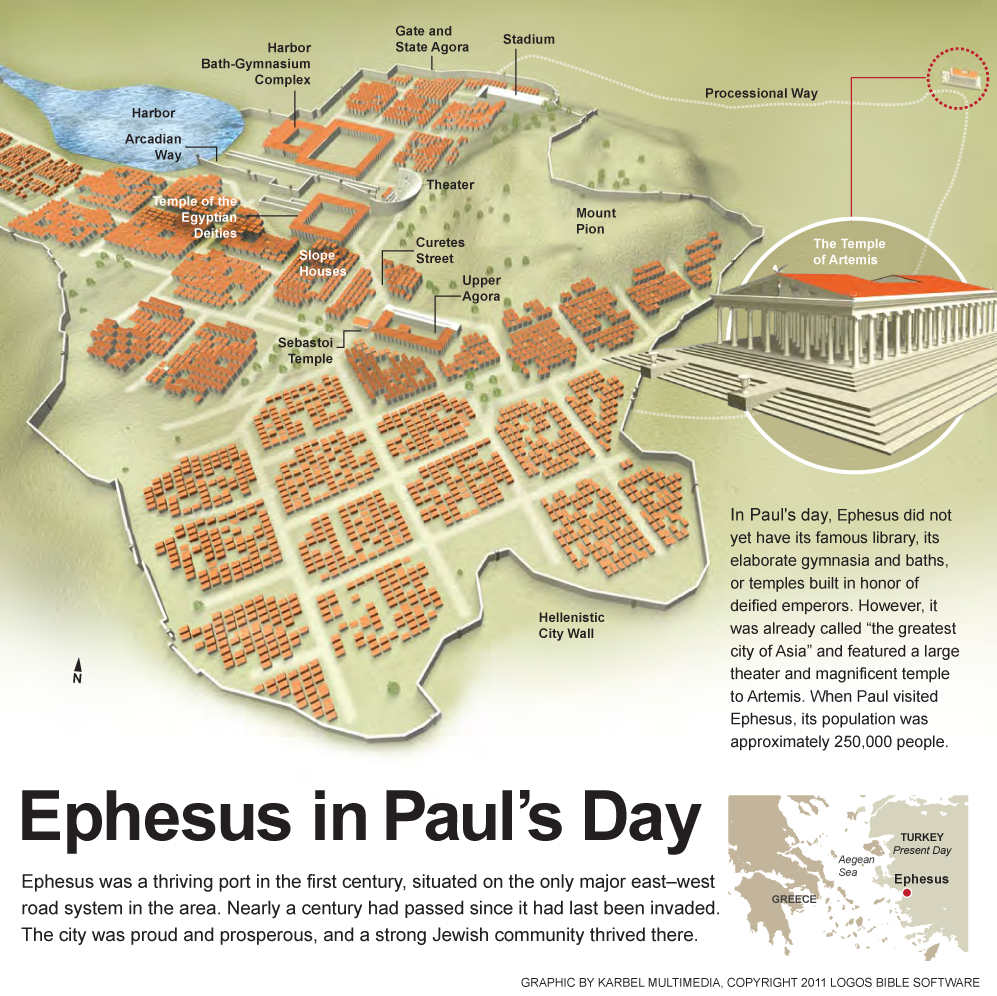
A Sketch of Ephesus by Mark Moore
1.
The fourth largest city of the Empire behind Rome,
Alexandria and Antioch.
2.
The Temple of Diana, destroyed by fire on the day of
Alexander the Great's birth, was one of the 7 wonders of the ancient world.
Although there are no remains of it today, it was four times the size of the
Agora of Athens.
a.
The Platform=239' x 418'; with 10 steps leading up to the
temple
b.
The Temple = 180' x 377'
c.
The Temple was surrounded by a large colonnade which had
117, 60' columns, each 6' in diameter, which held up the roof.
d.
36 of these columns were sculptured at the base with
life-sized figures. White, blue, red and yellow marble were used, as well as
gold.
e.
Diana of Ephesus was the many-breasted fertility goddess.
3.
The Agora (market) was 370' square, surrounded by a double
petitioned gallery behind which were the shops.
a.
The Gallery was made of Doric columns, probably put there by
Nero.
b.
In the center of the agora was large sundial, statues of
many famous citizens and a water clock.
4.
The Theater was on the western side of Mt. Pion.
a.
The Orchestra pit was 80' x 20'
b.
There were 3 bands with 22 rows of seats each, and 12
stairways of bands.
c.
It seated more than 25,000 people
d.
It was a mile and a half from the Temple of Diana.
e.
It was 495' in Diameter.
5.
The Hydrion was a two-story public water fountain.
6.
The Hestria was the public source of fire.
7.
The Curatia was the most important street in Ephesus paved
with white Egyptian marble.
8.
The roads had covered walkways on either side of the
streets; Chariots and horses drove in the center.
9.
The streets were guttered and some show evidence of a sewage
system beneath.
10.
There were public, portable light poles along the streets,
which could be removed during the day.
11.
The city had public toilets with constantly running water.
In one location there were more than 30 seats.
12.
The city had roman baths with ceramic clay pipes bringing
hot, cold and warm water to them.
13.
There were many brothels to meet the demand for
"worship" of Diana.
14.
There were perhaps as many as 300,000 people in Ephesus in
Paul's day.
15.
The supposed tomb of the apostle John is in Ephesus.
16.
The gospel became so prominent in Ephesus that on top of the
four pillars at the major intersection of the city were placed statues of
Matthew, Mark, Luke and John.
===================
Friday, March 24, 2023
Acts 18:18-28 Paul Returns to Antioch of Syria March 24
Paul Returns to Antioch of Syria
Acts 18:18-28
What do you like best about returning home after a long trip? What do you dread the most?
What is the worst haircut you ever had?
#God #People #Time #Place #Obedient faith #Sin #Key Idea
Paul Returns to Antioch
18After this, Paul stayed many days longer and then took leave of the
brothers and set sail for Syria, and with him Priscilla and Aquila. At Cenchreae he had cut his hair, for he was under a vow. 19And they came to Ephesus, and he left them there, but he himself went into the synagogue and reasoned with the Jews. 20When they asked him to stay for a longer
period, he declined. 21But
on taking leave of them he said, “I will return to you if God
wills,” and he set sail from Ephesus.
22When he had landed at Caesarea, he
went up and greeted the church, and then went down to Antioch. 23After spending some time there, he
departed and went from one place to the next through the region of Galatia and Phrygia, strengthening all
the disciples.
Apollos Speaks Boldly in Ephesus
24Now a Jew named Apollos, a native of Alexandria, came to Ephesus. He was an eloquent man, competent in the Scriptures. 25He had been instructed in the way of the Lord. And being fervent in spirit, he spoke and taught accurately the things concerning Jesus, though he knew only the baptism of John. 26He began to speak boldly in the synagogue, but when Priscilla and Aquila heard him, they took him aside and explained to him the way of God more
accurately. 27And when he wished to cross to Achaia, the
brothers encouraged him and wrote to the disciples to welcome him. When he arrived, he greatly helped those who through grace had believed, 28for he powerfully refuted the
Jews in
public, showing by the Scriptures that the Christ was Jesus.
- God is ... What do we learn about God in this passage?
- We are ... What do we learn about people in this passage?
- What do you make of his companions Priscilla and Aquila? What type of person was Apollos in Acts 18:24-26? What reason would Luke have for listing Priscilla ahead of Aquila (vv. 18, 26)?
- Paul appears to have taken a Nazirite vow (see Num. 6). What was the fundamental purpose of a Nazirite vow?
- What message was Apollos teaching the Jews at Ephesus? Was his message false? Was it bad? What was the problem with it?
- What wise and restrained response did Priscilla and Aquila make to Apollos’s teaching? What insights should we gain from their approach?
- What influence did Apollos have in Achaia, specifically Corinth as described in Acts 13:27-28 (See also 1 Corinthians 3:4-6? How did Priscilla and Aquila assist him? What does this tell you about the role of women in the New Testament?
- What missing elements made Apollos’s preaching incomplete?
- I will ... What has the Holy Spirit revealed to us in this passage? How can I apply it to my life this week?
- Who was very helpful to you when you were young and enthusiastic about the faith? How did this person help? Who could you help now? How?
- Where do you sense God has equipped you to serve?
- What role do women have in your church?
- How does your church balance evangelism with the strengthening and equipping of believers?
- You can ... Who do you know who needs to hear this? Feel free to share with others by social media links at the bottom of this.
Paul's Third
Missionary Journey
Acts 18:23–21:17. Estimated: 2700
miles, approximately 4 years in duration.
Planted no new churches as the record goes.
Place
|
Location
|
Events
|
1. Antioch
of Syria
|
18:23
|
Spent some
time here
|
2. Galatia & Phrygia
|
18:23
|
Strengthened
churches.
|
3. Ephesus
|
19:1
|
Holy
Spirit & 12 disciples. School of
Tyrannus.
Miracles. Riot with Demetrius.
|
4. Troas
|
2 Cor.
2:12–
13
|
Couldn't
wait for Titus.
|
5.
Macedonia
|
20:1
|
Exhorted
brethren.
|
6.
Philippi
|
20:5
|
Sailed
from here.
|
7. Troas
|
20:6
|
Broke
bread. Paul preached. Eutychus
|
8. Assos
|
20:13–14
|
Paul got
on board the ship.
|
9. Chios
& Samos
|
20:15
|
Places
where they stopped
|
10.
Miletus
|
20:15
|
Gave
address to Ephesian elders
|
11. Cos,
Rhodes, and
Patara
|
21:1
|
islands
where they stopped
|
12. Cyprus
|
21:3
|
Passed by
|
13. Tyre
|
21:3
|
The ship unloaded cargo. Paul visited friends.
|
14.
Ptolemais
|
21:7
|
Greeted
brethren.
|
15.
Caesarea
|
21:8
|
Visited
Philip. Agabus' prophecy.
|
16.
Jerusalem
|
21:15
|
Paul
follows the elder's advice. Paul is arrested.
|
Subscribe to:
Comments (Atom)